Case Study: StormBreaker 45T Blue Stormwater Solutions Accumulation Reuse System at Yuexiu Xingke Yuanqi (Under Construction)
Guang ShenZhen Industrial Park, Guangming District, Shenzhen, Guangdong Province
1. Project Overview
1.1 Basic Project Information
- Project Name: Yuexiu Xingke Yuanqi (Guang Sheng Industrial Park Urban Renewal Project)
- Location: Intersection of Guangqiao Road and Kexue Avenue, Xinhu Subdistrict, Guangming District, Shenzhen, Guangdong Province
- Project Phase: Under construction (Phase 1 expected to be delivered in H1 2028)
- Total Site Area: ~289 m²
- Total Gross Floor Area: ~700 m²
- Development Scale: 10 residential buildings (including 1 public rental housing building) + 1 kindergarten with 18 classes
- Core Green Initiative: StormBreaker modular rainwater harvesting, treatment, and reuse system (sponge city & water recycling demonstration)
1.2 Regional & Policy Background
Located in the core area of Guangming Science City—a national strategic science hub—the project aligns with Shenzhen’s “Sponge City” and wastewater/water recycling mandates.
- Shenzhen’s Strategic Goals: Achieve >80% reclaimed water utilization rate by 2026; implement 100 million m³ of tap water substitution via recycled water
- Guangming District’s Role: National pilot zone for full-scope reclaimed water utilization; municipal miscellaneous water reuse rate >95%
- Policy Drivers: Compulsory sponge city design for new developments; subsidies for rainwater recycling systems.
2. System Introduction: StormBreaker Stormwater Management Modules
2.1 Product Definition & Certification
StormBreaker (by Butler Manufacturing Services) is a high-strength, certified underground stormwater attenuation, infiltration, and storage modular system.
- Core Certification: CIRIA C737 & CIRIA C680 (UK industry standard for underground water storage)
- Void Ratio: 95% (extremely high storage efficiency)
- Material: Recyclable polypropylene (PP)
- Service Life: 50+ years (structural creep tested)
- Load Capacity: Supports H10–H20 traffic loads (pedestrian, light/heavy vehicle areas)
2.2 Core Technical Advantages
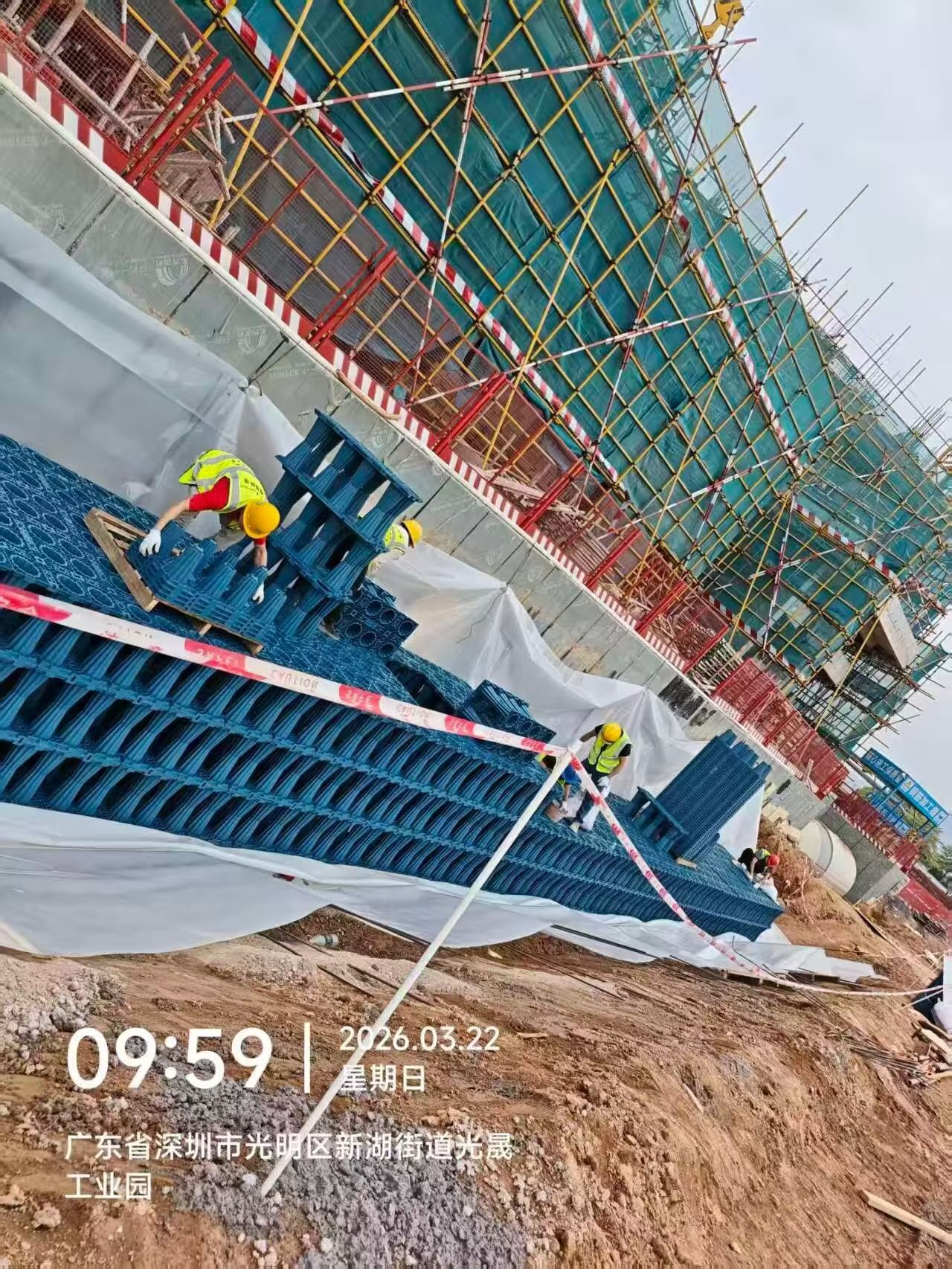
- Modular & Flexible: Stackable PP modules; customizable layout to fit underground spaces (basements, greenbelts).
- High Void Ratio: 95% void space maximizes rainwater storage vs. traditional concrete tanks.
- Lightweight & Quick Install: ~1/10 the weight of concrete; reduces structural load and shortens construction time.
- Corrosion Resistant: Anti-acid/alkali; no leakage or degradation; maintenance-free for long-term operation.
- Eco-Friendly: 100% recyclable; reduces carbon footprint vs. concrete.
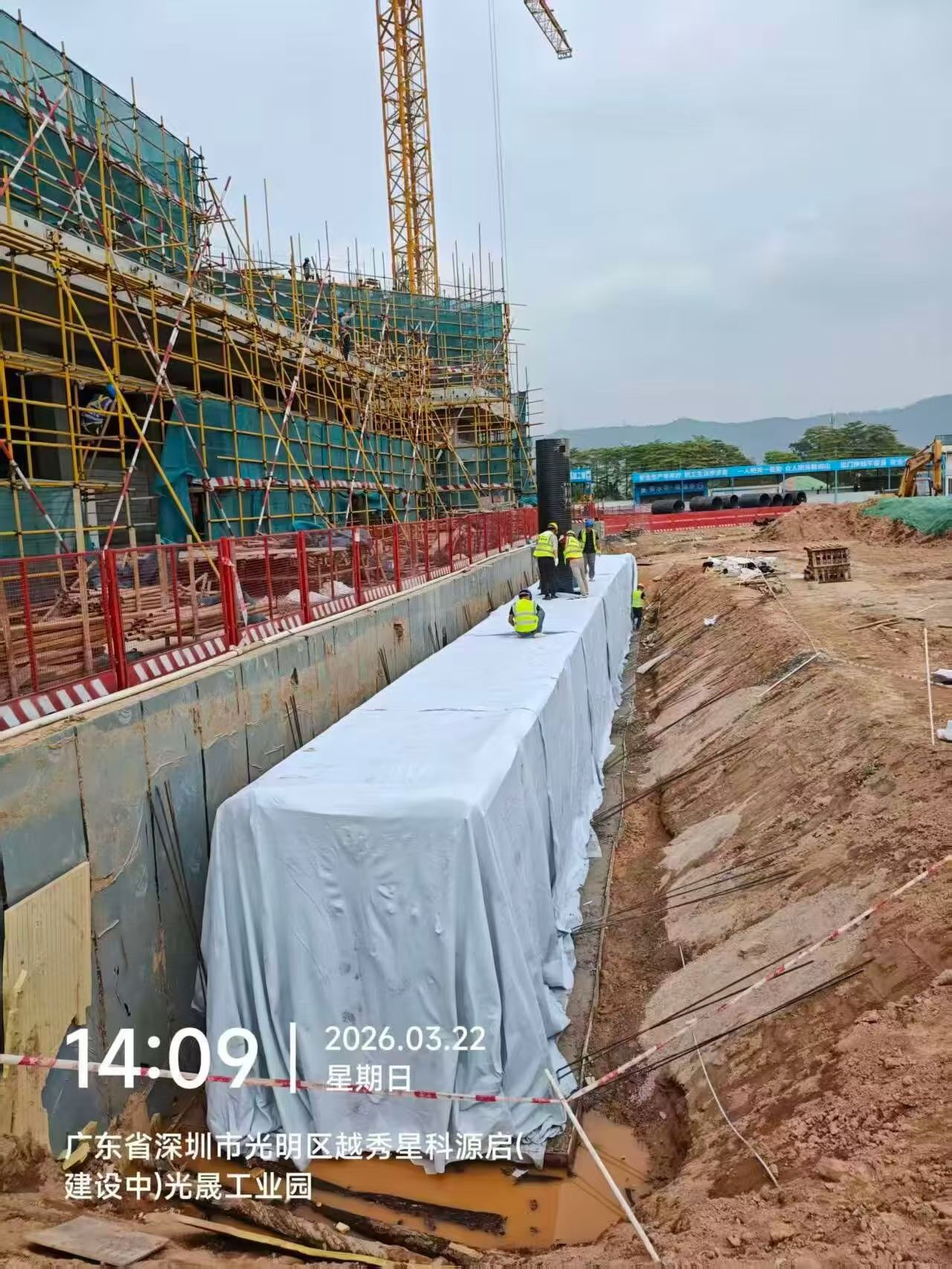
3. System Design & Implementation at Yuexiu Xingke Yuanqi
3.1 Catchment Area & Water Balance
- Total Catchment Area: ~28,000 m²
- Roof catchment: ~18,000 m² (primary clean source)
- Hardscape (roads, plazas): ~7,000 m²
- Permeable pavements & green areas: ~3,000 m²
- Annual Rainfall Capture: ~21,000 m³ (based on Shenzhen’s average annual rainfall: 1,933 mm)
- Target Reuse Rate: ≥95% of captured rainwater
3.2 Full Process Flow: Collection → Treatment → Storage → Reuse
Stage 1: Pre-Treatment & Initial Rainwater Diversion
- Roof Rainwater: Gutters → leaf filters → initial rainwater diverter (discards first 2–3 mm of polluted runoff) → sediment chamber.
- Surface Runoff: Permeable pavements/grass swales → grit chambers → oil-water separators (for parking areas).
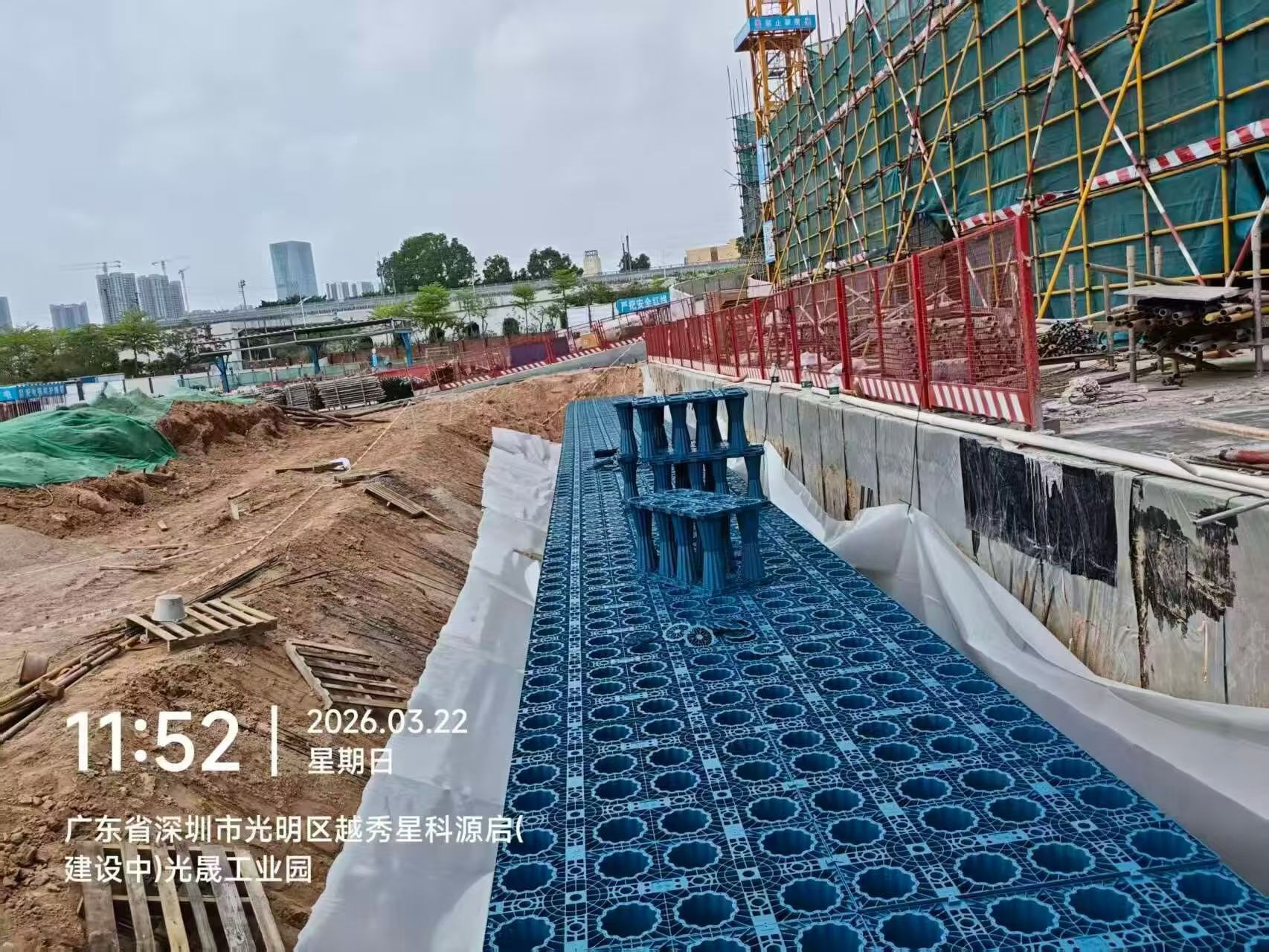
Stage 2: Underground Storage (StormBreaker Module)
- Installation Location: Underground green spaces and basement buffer zones (no aboveground footprint).
- Total Storage Volume: 1,200 m³ (using StormBreaker modules).
Structure: Waterproof geomembrane-wrapped modular tank; equipped with overflow pipes connected to municipal storm drains.
Stage 3: Advanced Purification
- Treatment Train:
- Multi-media filter (removes suspended solids)
- Activated carbon filter (adsorbs organics, odor, color)
- Ultraviolet (UV) disinfection (inactivates bacteria/viruses)
Stage 4: Smart Distribution & Reuse
- Smart Pumping Station: Variable-frequency drive (VFD) booster pumps; IoT monitoring (water level, quality, flow).
- Reuse Network: Dedicated pipe system separate from potable water.
- End Uses:
- Landscape irrigation (60%)
- Road cleaning & street washing (25%)
- Firefighting reserve & landscape water replenishment (5%)
3.3 Sponge City Synergy
- Combined with permeable pavements, bioretention ponds, and green roofs
- Reduces peak storm runoff by ~40%; mitigates urban flooding.
- Removes ~40% of runoff pollutants (SS, COD, nitrogen/phosphorus) before infiltration.
4. Performance, Benefits & Outcomes
4.1 Water-Saving & Economic Benefits
- Annual Tap Water Savings: ~13,650 m³
- Annual Cost Reduction: ~RMB 95,000 (at Shenzhen’s non-residential water rate: ~RMB 6.95/m³)
- Payback Period: ~6–7 years (including equipment, installation, O&M)
4.2 Ecological & Carbon Reduction Benefits
- CO₂ Emission Reduction: ~2.05 tons/year (0.15 kg CO₂ per m³ of reused rainwater)
- Groundwater Recharge: ~3,200 m³/year via infiltration
- Urban Heat Island Mitigation: Green infrastructure + irrigation lowers ambient temperature by 1.5–2°C
4.3 Social & Demonstration Value
- Guangming Science City Model: Integrates sponge city, water recycling, and low-carbon development
- Industrial Park Upgrade: Transforms old Guang Sheng Industrial Park into a green, smart, livable community.
- Policy Compliance: Meets Shenzhen’s mandatory sponge city and water-saving requirements
5. Key Challenges & Solutions
5.1 Space Constraints (High-Density Development)
- Challenge: Limited underground space in high-rise residential complex.
- Solution: StormBreaker’s high void ratio (94%) minimizes footprint; installed under landscape areas to avoid structural conflicts.
5.2 Water Quality Stability (Urban Runoff Pollution)
- Challenge: Variable influent quality (roof/surface runoff).
- Solution: Multi-stage pre-treatment + automatic backwashing filters + UV disinfection ensures consistent reuse quality.
5.3 O&M Complexity
- Challenge: Long-term stable operation for a large residential development.
- Solution: Smart IoT platform (remote monitoring, auto-alerts, predictive maintenance); simplified design for property management.
6. Conclusion & Industry Implications
The StormBreaker rainwater reuse system at Yuexiu Xingke Yuanqi is a state-of-the-art sponge city and water recycling demonstration in Guangming District, Shenzhen. By combining high-efficiency modular storage, advanced purification, and smart management, the project achieves:
- Water security: Reduces reliance on municipal water by 15–20% for non-potable use.
- Flood resilience: Enhances urban stormwater management.
- Sustainability: Lowers carbon emissions and supports ecological balance.
This case provides a replicable model for high-density urban residential and urban renewal projects across China and globally—proving that modern green building can harmonize development with water conservation and environmental protection.