1. Why Stormwater Is Now a Board-Level Risk in the U.S.
For U.S. developers, civil engineers and municipal owners, stormwater is no longer a “drainage line item.” It is a strategic risk that affects project approvals, public safety, long-term O&M cost and ESG performance.
Several structural trends explain why your expectations for stormwater partners are higher than ever:
-
More intense rainfall and flooding. U.S. data show that extreme single-day precipitation events have become significantly more common since 1910, with the share of the country experiencing these extremes increasing by about 0.5 percentage points per decade.US EPA Recent analyses of hourly rainfall in 144 U.S. cities find that 88% have seen higher rainfall intensity since 1970, with average hourly rates now about 15% higher than in 1970.climatecentral.org
-
Aging, underfunded stormwater infrastructure. In the American Society of Civil Engineers (ASCE) 2021 Report Card, stormwater infrastructure received its first grade ever: a “D”, reflecting decades of underinvestment and unclear funding responsibility.2021.infrastructurereportcard.org+2Stormwater Report+2
-
Stormwater as a major pollution pathway. Urban stormwater runoff is responsible for about 15% of impaired river miles in the U.S., and it carries a complex mix of pollutants such as sediments, nutrients, heavy metals, chloride and bacteria.stormwaterbook.safl.umn.edu+1 The U.S. EPA has long recognized urban runoff as a leading cause of water-quality impairment in coastal and estuarine waters.US EPA+1
-
Tighter regulatory and permitting expectations. Under the Clean Water Act, stormwater discharges from construction sites disturbing 1 acre or more require NPDES permit coverage, often via a Construction General Permit (CGP).US EPA+1 Municipal separate storm sewer systems (MS4s) must operate under permits that require comprehensive stormwater management programs to control pollutants in discharges.US EPA+1 Many states, such as California and Washington, have added their own stricter construction and municipal stormwater requirements on top of federal rules.Los Angeles Regional Water Board+2Los Angeles Regiona lWater Board+2
At the same time, the U.S. stormwater infrastructure and management market is large and growing, with estimates placing the U.S. stormwater management market at around USD 7.1 billion in 2023, expected to nearly double by 2032 at a CAGR close to 8%.SNS Insider+1 This scale reflects the value at risk—and the pressure on every decision-maker to choose systems that are robust, compliant and durable.
For this audience, price is important—but it is not the primary differentiator. The real question is:
Will this system reduce my risk, protect my project and make permitting easier over 30–50 years of service life?
2. How YudeRainEco Addresses the Priorities That U.S. Business Owners Actually Care About
Based on U.S. project trends, permitting frameworks, and owner expectations, the needs of American stormwater clients go far beyond competitive pricing. They want systems—and suppliers—that reduce regulatory friction, minimize engineering uncertainty, and deliver long-term asset value.
This is where YudeRainEco’s engineering-forward approach becomes a major advantage.
2.1 Regulatory and Permitting Certainty
U.S. developers and engineers must meet stringent federal, state, and municipal stormwater requirements.
YudeRainEco supports this need by delivering:
-
System designs aligned with the Clean Water Act, NPDES requirements for construction sites, MS4s, and industrial facilities.
-
Documentation that supports Stormwater Management Programs (SWMPs) and local stormwater manuals, including detention, retention, infiltration, and water-quality criteria.
-
Submission-ready packages: hydraulic calculations, storage curves, bypass routing, and overflow strategies prepared in formats familiar to U.S. plan reviewers.
What this means for clients: faster approvals, fewer RFIs, and significantly reduced permitting risk.
2.2 Structural Performance and Long-Term Reliability
Stormwater systems are buried assets expected to perform for decades under varying loads and soil conditions.
YudeRainEco ensures:
-
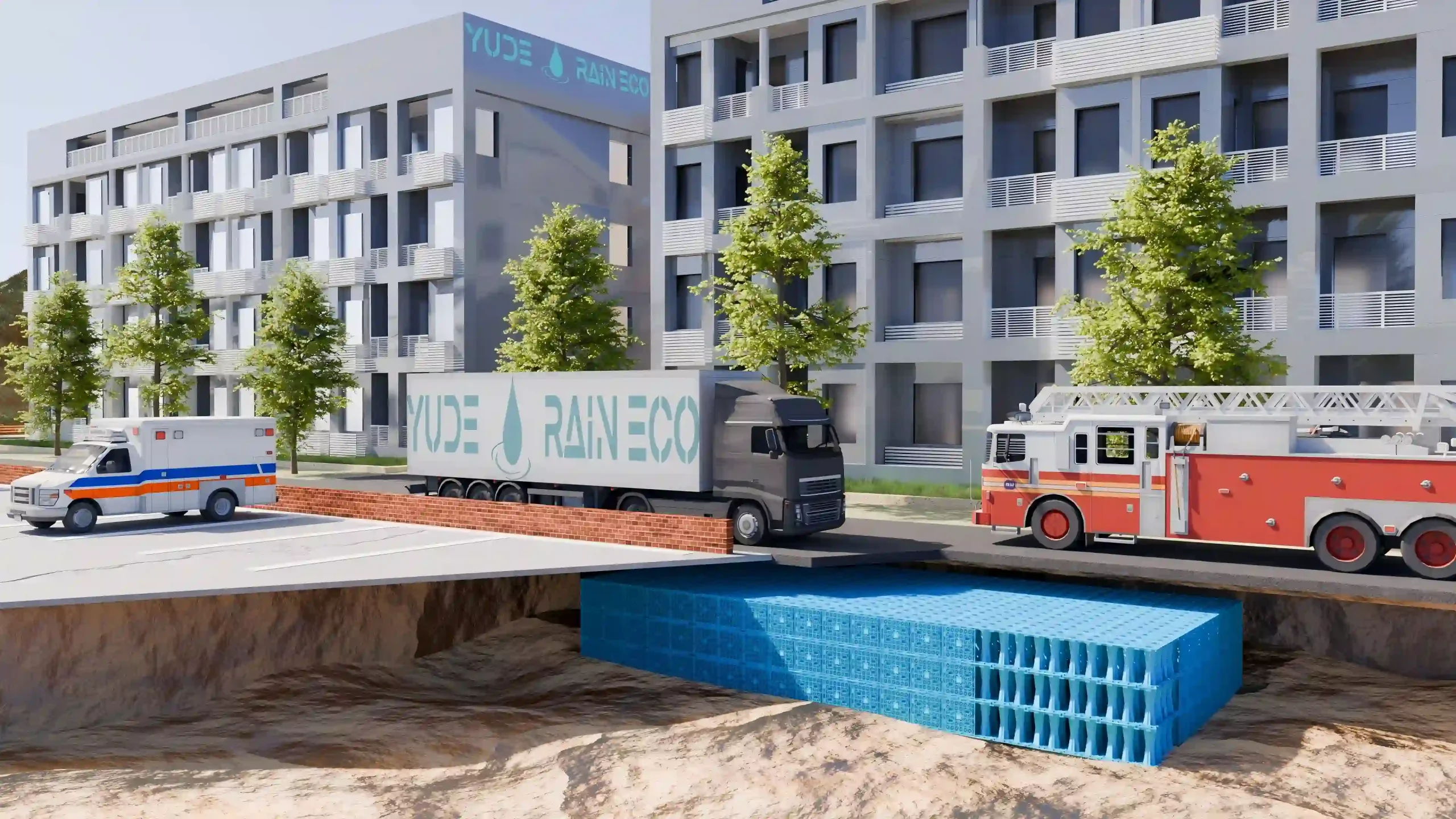
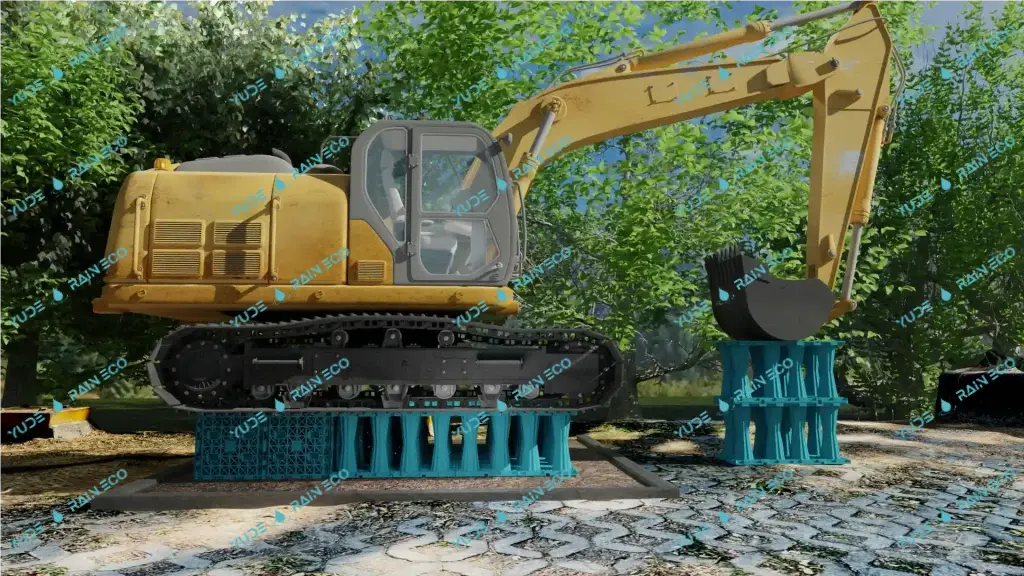
Verified live-load performance, including H-20/HS-20 traffic ratings where applicable.
-
Designs that consider creep behavior, settlement control, and differential loading to prevent long-term deformation.
-
Material transparency and testing protocols that mirror U.S. engineering practices.
Result: owners, engineers, and contractors gain confidence that the system will perform reliably—not simply at installation, but 15–30 years later when replacement would be costly and disruptive.
2.3 Water-Quality Outcomes — Not Just Storage Volume
Water quality remains a major driver of stormwater regulations across the U.S.
YudeRainEco systems support both:
-
Quantity management: detention, attenuation, controlled discharge, flood reduction.
-
Quality treatment: integration with pretreatment units, sedimentation stages, filters, separators and water-quality best practices.
YudeRainEco provides clear treatment-train recommendations that combine pretreatment, storage, and controlled release to support local TMDLs, MS4 obligations, and watershed plans.
Benefit: a single system that satisfies both hydraulic and environmental compliance requirements.
2.4 Constructability and Risk Reduction During Build-Out
U.S. contractors demand systems that install quickly, consistently, and safely.
YudeRainEco’s modular solutions deliver:
-
Straightforward installation sequences that reduce soil-work and minimize complexity.
-
Lower heavy-machine dependence, improving safety and reducing cost exposure.
-
Support from engineers who can guide contractors on unexpected field changes or challenging site conditions.
Outcome: shorter construction schedules, fewer field errors, and reduced potential for costly rework.
2.5 Documentation, Traceability, and QA/QC
U.S. clients expect documentation that withstands technical, regulatory, financial, and legal scrutiny.
YudeRainEco provides:
-
Comprehensive data sheets, structural guides, and hydraulic design notes.
-
Traceable material documentation, resin specifications, and qualified test reports.
-
As-built support documents and O&M manuals for long-term management.
Why it matters: complete documentation protects owners, engineers, and contractors over the entire lifecycle of the asset.
2.6 Supplier Stability and After-Sales Support
A stormwater system is a 30–50-year investment. The supplier must be equally reliable.
YudeRainEco offers:
-
Long-term technical availability across multiple project phases.
-
Responsive English-language support for contractors, municipalities, and consulting engineers.
-
A collaborative partnership mindset—not transactional shipping.
Advantage: clients know they are working with a partner that remains accountable long after installation.
3. How YudeRainEco Solves Your Key Pain “Stormwater Problem”
U.S. buyers often face frustration when evaluating international stormwater products.
YudeRainEco’s approach is intentionally built to eliminate those pain points.
3.1 “Low-Bid” Systems That Create Approval Headaches
Many imported systems offer low prices but fail during permitting because they lack:
-
U.S.-aligned design documentation
-
Clear correspondence with local codes
-
Reviewer-ready hydraulic and structural data
YudeRainEco differentiates itself by providing engineering-grade, submission-ready documentation, reducing the risk of redesigns and permitting delays.
3.2 Unclear Alignment with U.S. Regulations
Without explicit references to NPDES, MS4 permits, SWMP obligations, or CGP/SWPPP requirements, U.S. engineers must fill in gaps—creating risk and extra workload.
YudeRainEco eliminates this by:
-
Designing systems within recognized regulatory frameworks
-
Providing documentation that clearly fits into U.S. compliance structures
Result: easier approvals and less regulatory interpretation burden for the design team.
3.3 Insufficient Structural and Material Transparency
U.S. engineers expect full visibility into:
-
Load assumptions
-
Material properties and creep performance
-
Test methods and verification data
YudeRainEco provides transparent structural logic, verifiable testing, and conservative design assumptions, enabling engineers to confidently stamp designs.
3.4 Logistics and Lead-Time Risk
Unpredictable deliveries can jeopardize construction schedules.
YudeRainEco mitigates this with:
-
Clear incoterms and shipping control
-
Detailed lead-time planning
-
Proactive communication and full shipment traceability
Outcome: fewer schedule disruptions and higher contractor confidence.
3.5 Limited Lifecycle Support
Some suppliers disappear after shipping the product—leaving asset owners unsupported.
YudeRainEco provides:
-
Long-term O&M documentation
-
Training materials for maintenance teams
-
Ongoing engineering assistance for expansion, modification, or troubleshooting
This ensures that your stormwater system remains compliant and functional for decades—not just at installation.
4. YudeRainEco Systems and Solutions for U.S. Projects
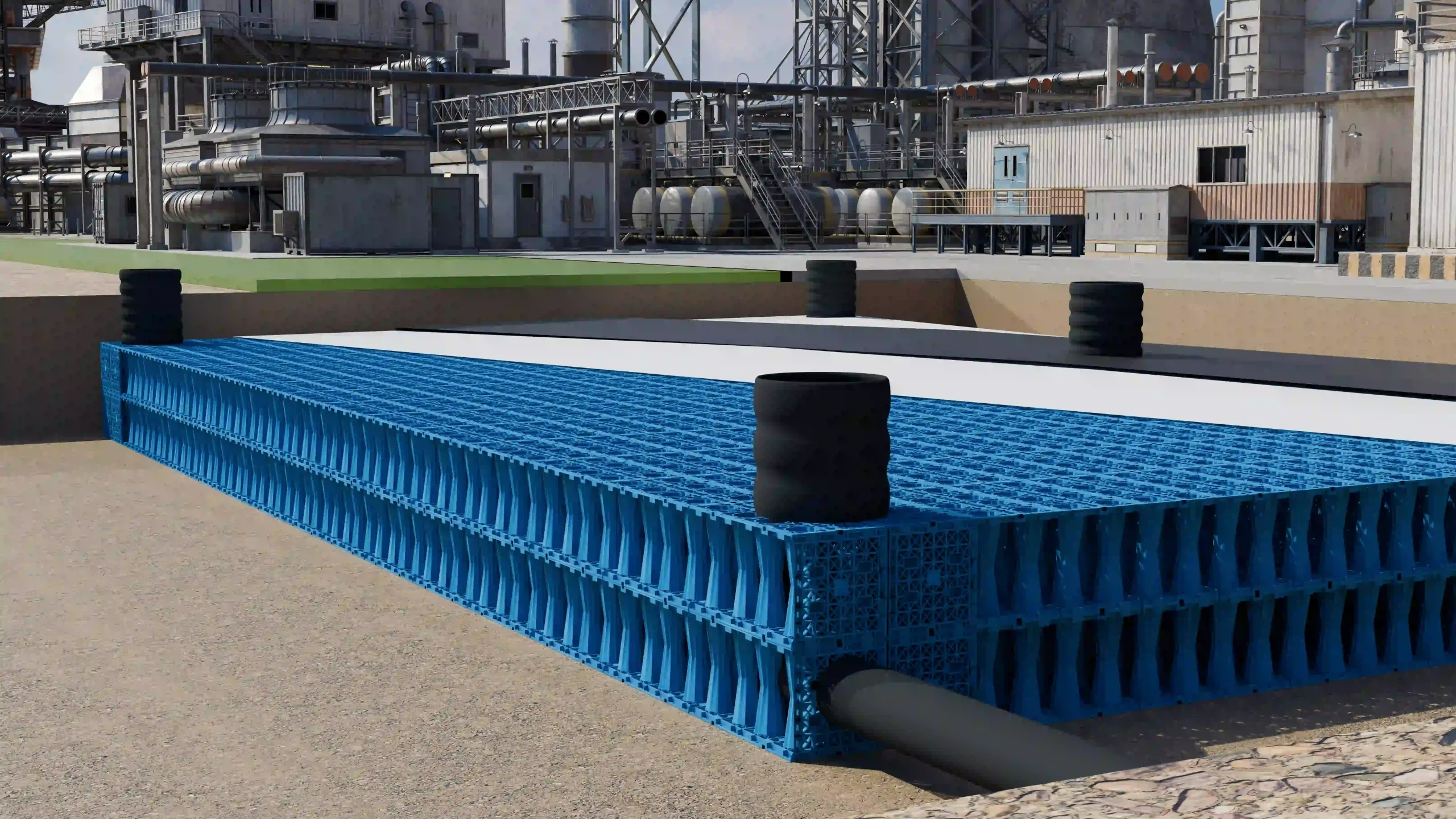
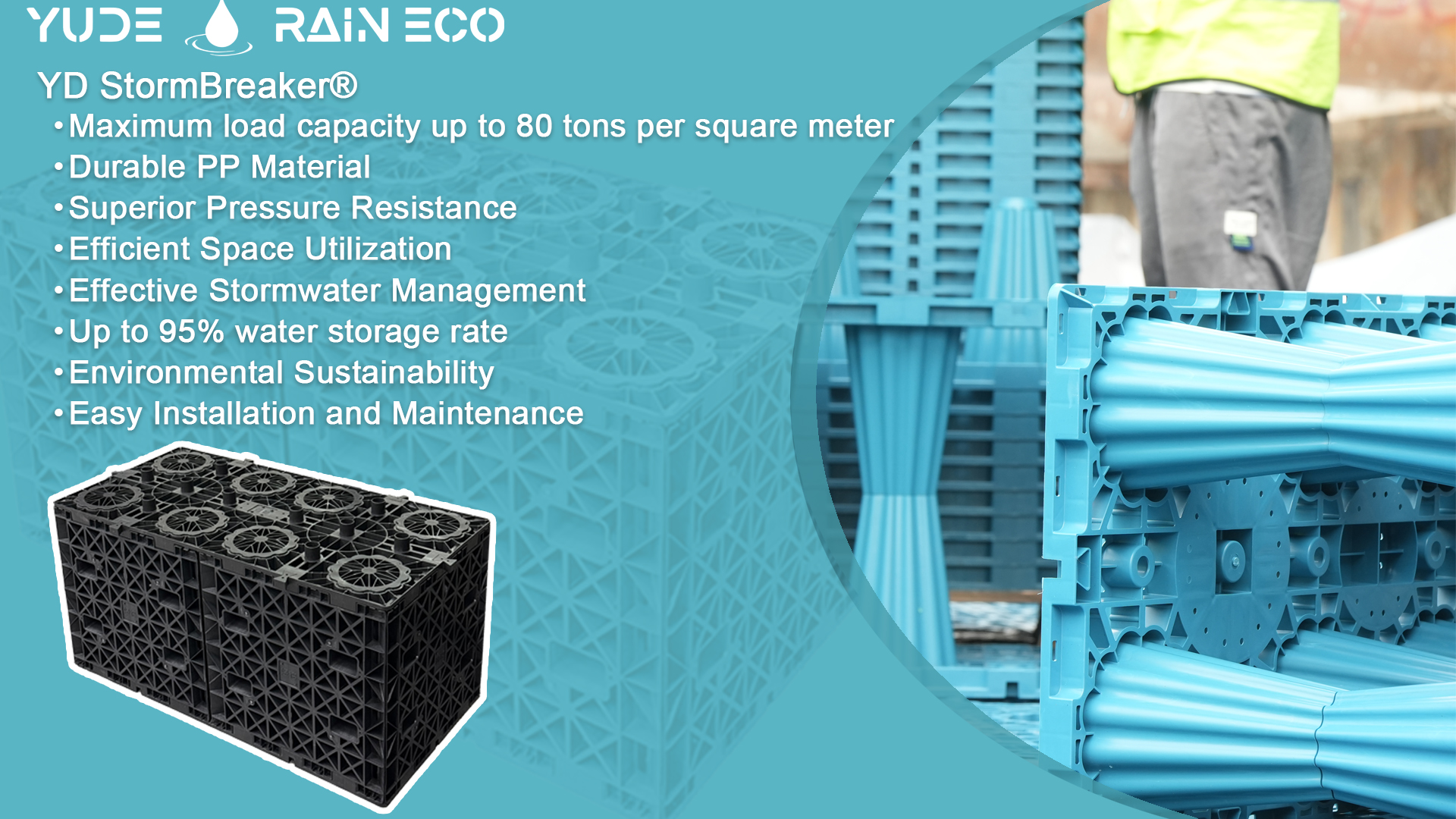
To respond to these priorities, YudeRainEco does not offer a single “one-size-fits-all” tank. Instead, we provide a family of modular underground systems that can be configured for infiltration, attenuation, and rainwater harvesting, built around heavy-duty structural modules such as StormBreaker 60–100T.
4.1 Underground Modular Infiltration Systems
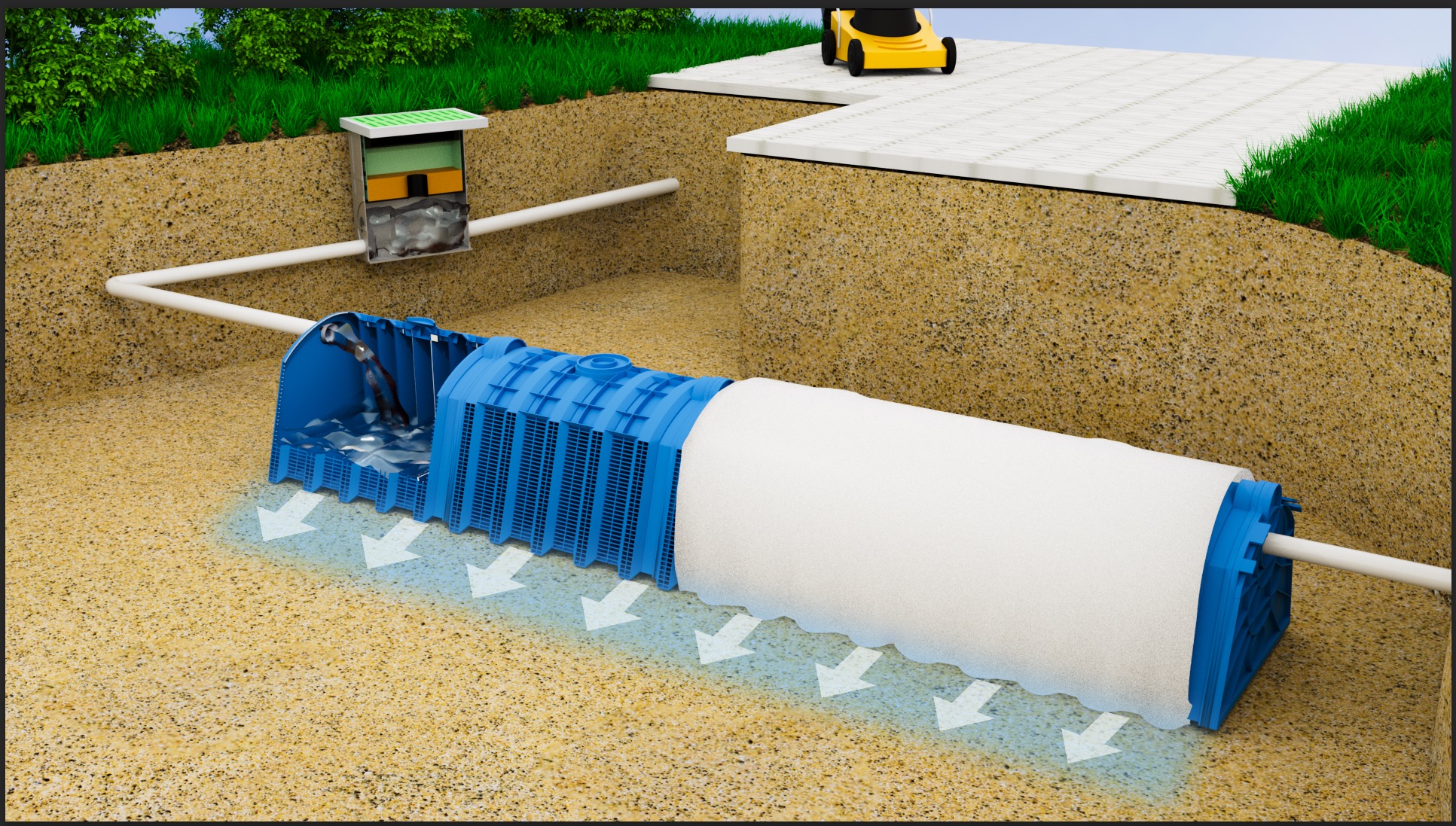
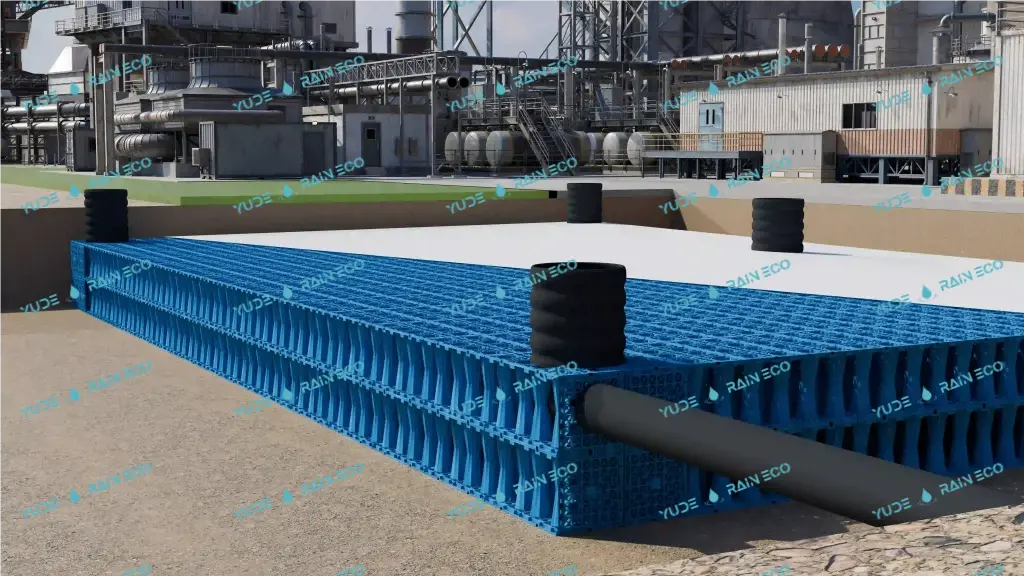
For sites where soils and groundwater conditions allow infiltration, YudeRainEco designs modular underground infiltration systems that:
-
Receive runoff from paved areas, roofs, or green infrastructure elements.
-
Temporarily store water within high-void modules before allowing gradual infiltration into the surrounding soil.
-
Reduce pressure on downstream pipes and open channels, while supporting local groundwater recharge and stream baseflow.
These systems are well suited for residential subdivisions, commercial projects, distribution centers with large parking areas, and municipal retrofits where reducing downstream peak flows and volumes is a priority.
4.2 Attenuation (Detention) Systems for Peak-Flow Control
Where infiltration is limited or not permitted, YudeRainEco supplies attenuation systems that focus on peak-flow reduction and controlled discharge:
-
Modular crates are configured to create an underground detention volume that stores runoff during the design storm.
-
Outlet controls (orifices, weirs, or control structures) are sized to match local allowable discharge rates and pre-development flow targets.
-
Systems are designed to integrate smoothly with downstream storm sewers, channels, or surface facilities.
By combining our structural modules with project-specific hydraulic modeling support, we help U.S. engineers demonstrate compliance with municipal detention requirements and MS4 objectives.
4.3 Rainwater Harvesting and Reuse Systems
For owners who want to reduce potable water consumption and improve ESG performance, YudeRainEco designs rainwater harvesting and reuse systems that can:
-
Capture roof runoff or other suitable sources into underground storage built from our modular units.
-
Integrate with filtration and disinfection as needed for non-potable uses.
-
Supply irrigation networks, cooling towers, equipment washdown, or other utility uses.
This approach allows developers, industrial facilities, and campus owners to turn stormwater from a liability into a long-term resource, supporting LEED, SITES, and corporate water stewardship goals.
4.4 StormBreaker 60–100T: Heavy-Duty Structural Modules
At the core of many YudeRainEco systems are our StormBreaker 60–100T heavy-duty modular units, engineered for demanding underground applications:
-
High structural capacity modules that can be designed for traffic loading, including truck and fire-lane applications when properly engineered and installed.
-
Modular geometry that allows flexible footprints and depths, optimizing excavation costs and site constraints.
-
Compatibility with both infiltration and lined detention systems, as well as harvesting applications where watertight configurations are required.
By using StormBreaker 60–100T as a common platform, U.S. clients can standardize on a single, robust module family across multiple projects—whether the primary goal is infiltration, detention, or reuse—while still tailoring each system to local regulations and site conditions.
5. How YudeRainEco Delivers High-Value, Compliance-Driven Solutions for U.S. Stormwater Projects
Yude Rain Eco focuses on modular stormwater and rainwater systems—such as underground attenuation and retention structures, infiltration tunnels and related components—designed to support modern urban drainage strategies.
We totally understand, for U.S. clients, the value is not “cheaper products from overseas.” The value is in risk-controlled, engineering-driven delivery.
5.1 Design Support Tailored to U.S. Practice
A capable international supplier should be able to:
-
Translate your project criteria (design storm, target detention volume, allowable discharge, water-quality objectives) into a complete system layout.
-
Provide hydraulic calculations (storage volume, outflow hydrographs, orifice and weir sizing) suitable for submittal to local authorities.
-
Coordinate with your local civil or structural engineer of record so final designs align with state and municipal requirements.
Yude Rain Eco can collaborate with your design team to turn conceptual drainage requirements into fully engineered modular underground systems, ready for review and approval.
5.2 Structural Safety and Load-Bearing Confidence
For your. projects, you can expect from a serious stormwater partner:
-
Modular PP systems engineered for vehicular and fire-truck loading where required, with clear design charts and installation guidelines.
-
Attention to backfill specification, compaction, and cover depths to avoid settlement and localized overstress.
-
Consideration of long-term creep and soil interaction under sustained loads.
Yude Rain Eco designs its systems with these long-term structural considerations in mind, supporting your engineer with the technical information required to check and confirm performance under U.S. loading conditions.
5.3 Integration with Water-Quality and Green Infrastructure Goals
Given EPA and MS4 expectations around pollution control and green infrastructure,US EPA+1 a modern supplier should help you:
-
Integrate pretreatment devices (catch basin inserts, sediment traps, hydrodynamic separators) upstream of underground systems.
-
Combine detention, infiltration and reuse strategies to support local TMDLs, watershed plans and sustainability goals.
-
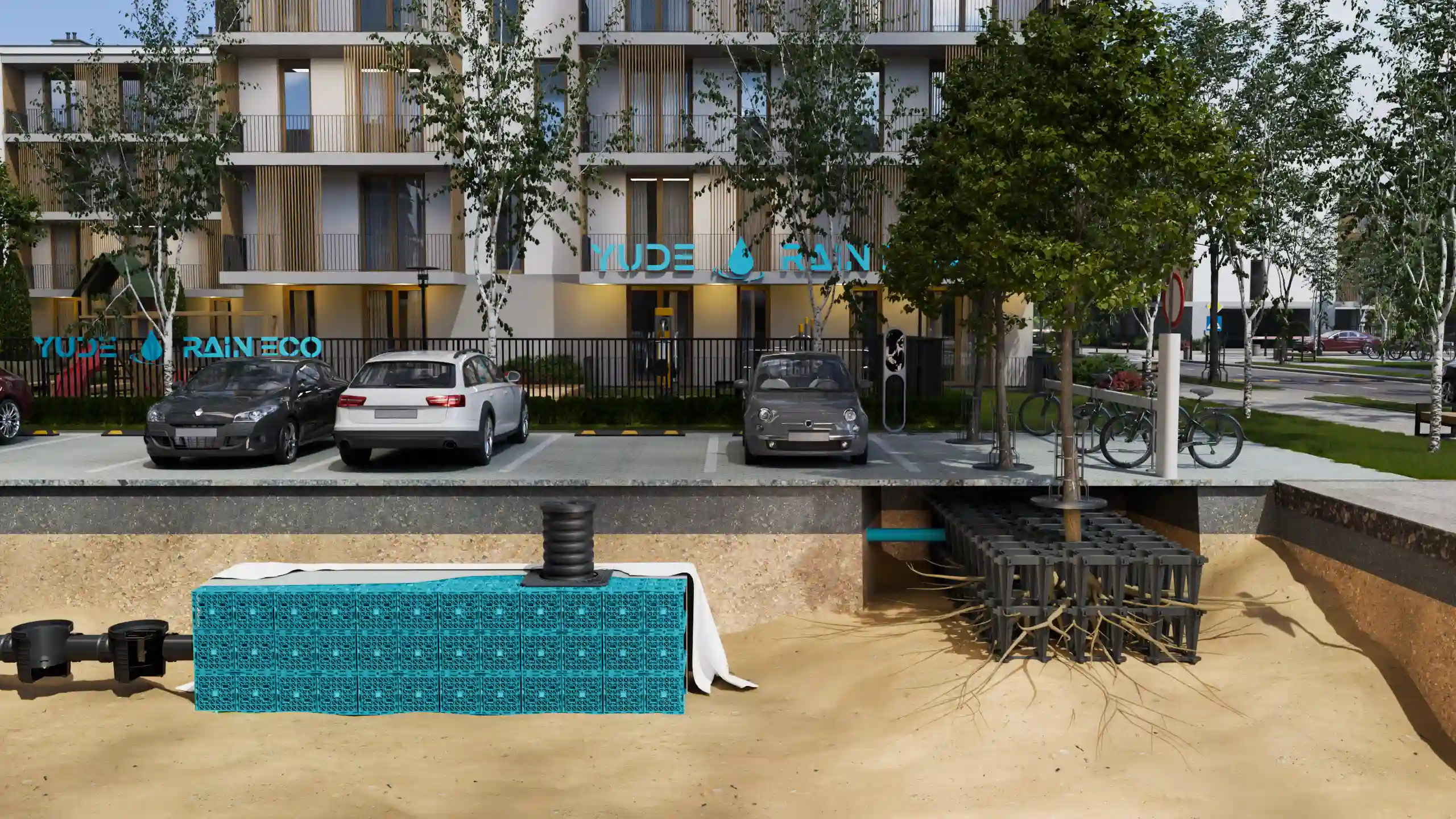
Connect underground storage with bioretention, permeable pavements and tree-root systems as part of a broader low-impact development (LID) strategy.
Yude Rain Eco’s modular systems can be configured to support both traditional detention/infiltration and more advanced green-blue infrastructure approaches.
5.4 Clear, Traceable Documentation
To satisfy U.S. owners and reviewers, Yude Rain Eco can prepare documentation packages that typically include:
-
System data sheets, installation manuals and typical details.
-
Structural and hydraulic design support materials.
-
Material specifications and test reports from qualified laboratories, where applicable.
-
O&M guidance for long-term inspection, cleaning and performance verification.
This documentation is critical not just for first approval, but for future refinancing, due diligence and asset sales, where stormwater systems may be evaluated as part of environmental risk.
5.5 Reliable Logistics and Communication
For U.S. clients sourcing from abroad, success depends on:
-
Transparent lead-time planning, aligned with your construction schedule.
-
Clear incoterms and responsibilities for customs, inland transport and delivery sequencing.
-
Proactive communication when conditions change (weather, port congestion, regulatory changes).
Yude Rain Eco treats logistics as part of the engineering solution—not an afterthought—so that your stormwater system arrives complete, on time and ready to install.
6. How Use Modular Underground Systems in Practice
6.1 Residential and Mixed-Use Developments
Pain point: Developers must meet municipal detention and water-quality requirements without reducing developable area.
Solution pattern:
-
Use underground modular attenuation tanks beneath parking lots, drive aisles or open spaces.
-
Integrate orifice-controlled outlets to match post-development peak flows to pre-development conditions.
-
Add upstream pretreatment to capture sediment and debris, reducing maintenance inside the tank system.
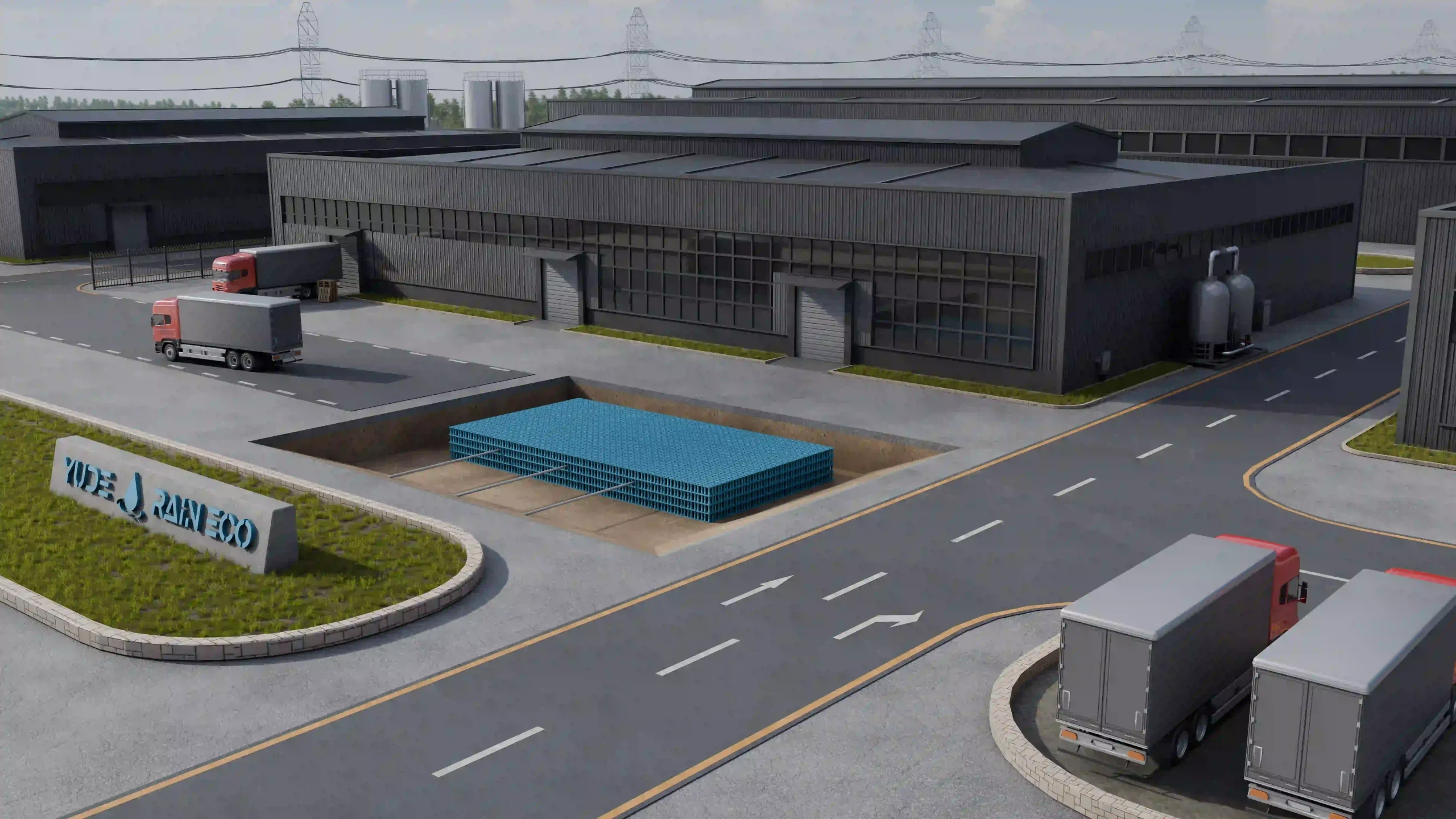
6.2 Big-Box Retail, Warehouses and Logistics Parks
Pain point: Very large roof and pavement areas produce high peak flows, while sites are often flat and heavily constrained.
Solution pattern:
-
Distribute multiple underground systems across the site to reduce pipe sizes and excavation depth.
-
Design for truck and fire-lane loading with conservative cover depths and backfill requirements.
-
Combine detention and reuse (e.g., irrigation or non-potable industrial uses) to support ESG and corporate water-stewardship goals.
6.3 Industrial Facilities and Regulated Sites
Pain point: Facilities subject to industrial stormwater permits must control both volume and pollutant loadings in runoff. Los Angeles Regiona lWater Board+1
Solution pattern:
-
Integrate modular storage with treatment trains that target specific pollutants (metals, hydrocarbons, TSS).
-
Provide clearly documented maintenance procedures to satisfy permit reporting.
-
Ensure materials, joints and designs are compatible with site chemicals and operational risks.
6.4 Municipal Green Infrastructure and Urban Retrofits
Pain point: Older neighborhoods need flood relief and water-quality improvements, but surface space is limited and existing utilities are dense.
Solution pattern:
-
Use compact, high-void-ratio underground modules beneath streets, plazas or parks.
-
Connect systems to bioswales, permeable pavements and tree pits to increase infiltration where soils permit.
-
Phase projects to match annual municipal budgets while building toward a long-term stormwater masterplan.
7. As a Developer, Owner, Contractor, Engineering Consultant, Facility Operator, or Distributor — Here’s What You Gain
1. Faster permitting and smoother approvals
-
Submission-ready hydraulic models, design notes and drawings reduce reviewer back-and-forth.
-
Systems aligned with MS4, SWPPP, NPDES CGP and state stormwater manuals accelerate approvals.
2. Documentation that protects you legally and financially
-
Material traceability, testing records and engineering documentation strengthen your position during audits, refinancing, insurance reviews and potential disputes.
-
Long-term O&M documentation ensures asset continuity.
3. Lower construction risk and predictable scheduling
-
Modular systems reduce weather sensitivity, lower heavy-equipment requirements and minimize installation errors.
-
Contractors benefit from clearer sequencing and fewer unforeseen conditions.
4. Predictable long-term maintenance cost
-
Inspectable, maintainable systems reduce whole-life cost and prevent failure-driven emergency repairs.
-
Supports decades of operational compliance.
5. Higher ESG and sustainability value
-
Enables LEED/SITES credits and meets corporate water stewardship goals.
-
Supports rainwater reuse strategies that reduce municipal water dependency.
6. Reduced liability
-
Robust engineering documentation reduces exposure related to structural failures, flooding events or water-quality violations.
7. Stronger sales capabilities for distributors
-
Complete technical packages make systems easier to sell to engineers, municipalities and contractors.
-
Supports multiple market verticals: residential, commercial, industrial, municipal and green infrastructure.
8. A genuine long-term partner
-
Ongoing design support across multiple projects
-
Responsive technical guidance
-
Ability to adapt solutions to evolving regulations and site conditions
8. A Practical Checklist for Buyers Evaluating International Stormwater Suppliers
When you evaluate an international partner such as Yude Rain Eco, use a risk-focused checklist rather than just comparing unit prices:
-
Regulatory Fit
-
Can they support designs that align with NPDES, MS4 and state/local stormwater manuals?
-
Do their proposals explicitly address detention, retention, reuse and water-quality objectives?
-
-
Technical Transparency
-
Are structural design assumptions and load ratings clearly presented?
-
Are material properties and testing methods explained and documented?
-
-
Design and Submittal Support
-
Will they provide calculations, drawings and technical narratives suitable for U.S. plan review?
-
Can they coordinate effectively with your local PE and permitting authority?
-
-
Quality Assurance and Traceability
-
Do they maintain consistent manufacturing standards and batch traceability?
-
Can they provide test reports from recognized laboratories where needed?
-
-
Installability and Training
-
Are installation manuals clear, with practical details on excavation, backfill, compaction and inspection?
-
Can they support remote training or field guidance for your crews?
-
-
Lifecycle Commitment
-
Will they support O&M teams with long-term documentation and advice?
-
Are they prepared to help troubleshoot if site conditions or regulations change?
-
A supplier that performs strongly against this checklist will reduce your project risk, not just your material bill.
9. Work with Yude Rain Eco as Your Quality-Driven Stormwater Partner
If you are a U.S. civil engineer, developer, contractor or municipal owner, you are likely dealing with:
-
Increasingly intense rainfall and flood risk.US EPA+2climatecentral.org+2
-
Tightening environmental expectations around stormwater quality and green infrastructure.US EPA+1
-
Aging infrastructure graded “D” that must be upgraded without disrupting communities.2021.infrastructurereportcard.org+1
In this context, choosing a stormwater partner is fundamentally about risk management, compliance and long-term performance.
Yude Rain Eco works with international clients to:
-
Design modular underground stormwater detention, retention and rainwater reuse systems that fit local regulatory frameworks.
-
Provide engineering-grade documentation to support approvals and design reviews.
-
Deliver consistent product quality and technical support over the lifecycle of your assets.
Call to Action
If you are planning or reviewing a project in the U.S. and want to explore how modular underground systems can reduce your stormwater risk and construction footprint, you can:
-
Send us your site plan and basic criteria (catchment area, design storm, target detention volume, reuse goals).
-
Request a preliminary concept layout and volume estimate, along with a discussion of how to integrate local permitting requirements.
-
Discuss how Yude Rain Eco can support pilot projects that demonstrate performance and build internal confidence.
Yude Rain Eco never competes on price—we focus on delivering compliance-ready engineering, long-term reliability, and documentation that reduces your regulatory, construction, and operational risks.
Contact Yude Rain Eco:
-
Email: [email protected]
-
Company Tel: +86 400-888-2852
We welcome who are looking for a long-term, quality-first partner in stormwater and rainwater infrastructure.
Frequently Asked Questions (FAQ)
1. What makes a stormwater system “compliance-ready” for U.S. projects?
A compliance-ready system is one that includes documentation, calculations, and performance data aligned with U.S. regulatory frameworks such as the NPDES program, MS4 permits, SWPPPs, and local detention/infiltration standards.
This includes hydraulic models, structural information, storage–outflow curves, and clear installation requirements that satisfy municipal reviewers.
2. Are modular stormwater systems suitable for traffic loading such as fire lanes or parking lots?
Yes—when properly designed and installed.
YudeRainEco’s StormBreaker 60–100T modules are engineered for high load-bearing capacity and can be used beneath vehicular areas when supported by appropriate cover depth, backfill specifications, and structural checks.
3. How do I know whether my project needs infiltration, detention (attenuation), or rainwater harvesting?
It depends on local regulations and site conditions:
-
Infiltration is preferred where soils and groundwater allow it.
-
Detention is required where peak-flow control or downstream flooding mitigation is the priority.
-
Rainwater harvesting is chosen when owners want to reduce potable water use or pursue ESG/LEED goals.a
YudeRainEco can evaluate site constraints and recommend the correct system configuration.
4. Do U.S. municipalities accept modular plastic stormwater systems?
Yes. Modular PP systems are widely accepted across the U.S., provided they include:
-
Verified structural performance
-
Hydraulic modeling supporting detention/retention requirements
-
Clear maintenance access strategy
-
Compliance with local stormwater manuals
YudeRainEco supplies all required engineering documentation to support approval.
5. How does YudeRainEco support the permitting process?
We provide U.S.-style engineering documentation, including:
-
Hydraulic calculations (inflow/outflow modeling)
-
Storage volume curves
-
Outlet structure sizing
-
Layout drawings and system details
-
Material and structural data
These documents significantly reduce RFI cycles and accelerate approval.
6. What are the long-term maintenance requirements for modular stormwater systems?
Maintenance depends on system type:
-
Pretreatment units require periodic cleaning.
-
Detention systems should be inspected for sediment accumulation and inlet/outlet performance.
-
Infiltration systems must maintain surface permeability and pretreatment efficiency.
YudeRainEco provides O&M manuals and guidance tailored to each installation.
7. Can stormwater systems help with corporate ESG or LEED/SITES certification?
Absolutely.
Infiltration, detention, and harvesting systems contribute to:
-
Stormwater performance credits
-
Water efficiency credits
-
Green infrastructure requirements
-
Reduced potable water usage for irrigation or industrial processes
YudeRainEco systems support sustainable design strategies across commercial and municipal projects.
8. Why choose StormBreaker 60–100T over traditional concrete chambers or low-cost crates?
StormBreaker modules offer:
-
Higher load capacity
-
Modular flexibility for tight or irregular sites
-
Lightweight installation without heavy equipment
-
Scalability for infiltration, detention, or harvesting
-
Documentation transparency that simplifies U.S. approvals
They also provide lifecycle advantages through easier installation and lower long-term risk.
9. Can YudeRainEco assist with preliminary sizing if only basic project information is available?
Yes.
With catchment area, design storm, allowed discharge, soil type, and project objectives, we can prepare a preliminary concept layout and volume estimate to support early design discussions or budget planning.
10. How quickly can YudeRainEco support U.S. partners with technical questions?
We offer responsive English-language support across time zones, providing assistance for RFIs, design adjustments, site-specific challenges, and permitting requirements.
Our approach is partnership-driven, not transactional.